The best-selling pickup trucks in America aren’t always the safest, as we’ve seen in the full-size segment. Here, the Ram 1500 has better safety ratings than the popular Ford F-150—and the Toyota Tundra is safer than both. But what if you want a safe pickup in the class below? In this segment, the Toyota Tacoma leads on the sales charts, but is it also the safest? To find out, we’ve compared it with the Chevy Colorado and Jeep Gladiator. These results are based on 2026 ratings from the Insurance Institute for Highway Safety (IIHS).
Crashworthiness: Colorado Falls Behind
The midsize segment isn’t off to a great start, as not a single model currently qualifies for the Top Safety Pick or Top Safety Pick+ awards from the IIHS. In the crashworthiness category, the safety authority conducts the following tests: small overlap front, involving the vehicle striking another vehicle or object with its front corner; the moderate overlap front, which is an offset crash between two vehicles; and the side test, which determines the structural integrity of a vehicle’s side. Each test is rated Good, Acceptable, Marginal, or Poor, so here’s a look at how these midsize pickups fared.
|
Toyota Tacoma |
Chevrolet Colorado |
Jeep Gladiator |
|
|
Small Overlap Front |
Good |
Good |
Acceptable |
|
Moderate Overlap Front |
Not Tested |
Marginal |
Good |
|
Side |
Good |
Good |
Good |
The Toyota was not evaluated for the moderate overlap front yet, so can’t qualify for a safety award. The Colorado is immediately disqualified for an award due to a Marginal rating in this test, where there was a heightened risk for head, neck, and chest injuries for rear-seat occupants. The Jeep was better overall, but its merely Acceptable rating in the first test disqualified it from an award, as the driver could experience an increased risk for lower leg and foot injuries.
If the Tacoma can ace its moderate front overlap test, it will be the sturdiest of the three for crashworthiness. Due to the Colorado’s one Marginal result, it currently ranks behind its two rivals.
Related: Ford Explorer Vs. Toyota Grand Highlander: Which Three-Row SUV is Safer?
Crash Prevention: Toyota Best at Avoiding a Crash
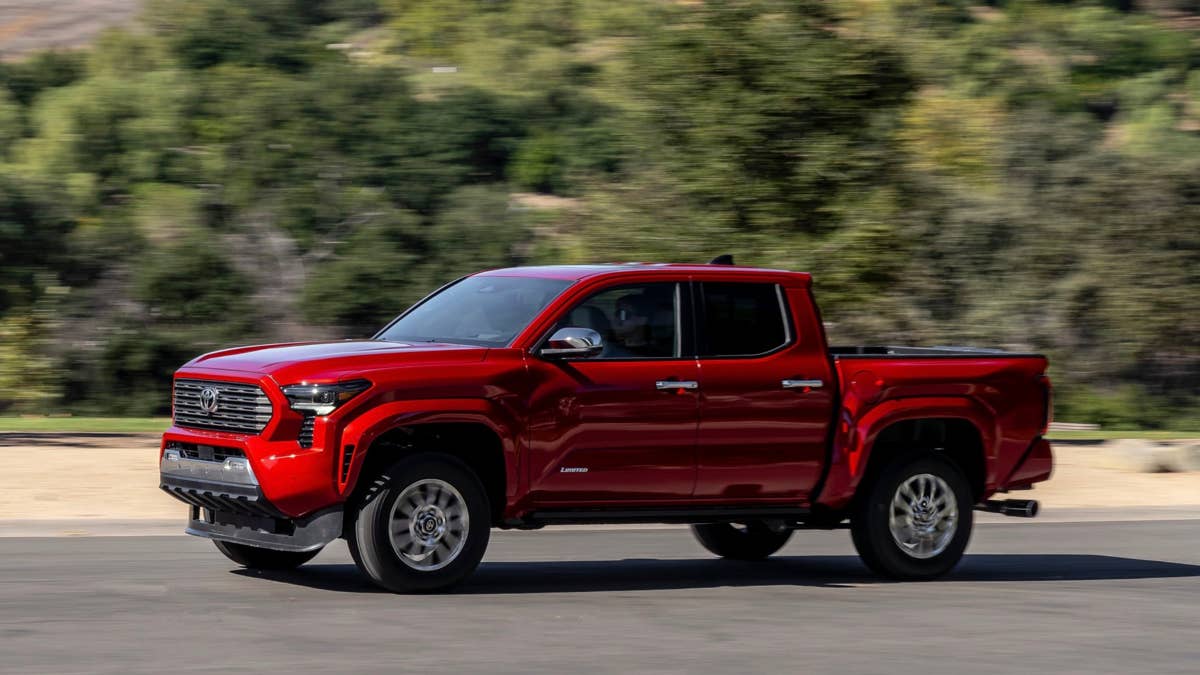
Toyota
Modern safety involves a vehicle’s ability to avoid a crash, not just protect occupants if the worst happens. Here, the IIHS tests the headlights, along with each pickup’s ability to avoid a collision with another vehicle or a pedestrian.
|
Toyota Tacoma |
Chevrolet Colorado |
Jeep Gladiator |
|
|
Headlights |
Acceptable |
Not Tested |
Marginal (LED projector); Poor (halogen) |
|
Crash Prevention (vehicle-to-vehicle) |
Good |
Poor |
Not Tested |
|
Crash Prevention (vehicle-to-pedestrian) |
Good |
Acceptable |
Poor |
In tests that were completed, the Toyota outshines its rivals. It scored a Good rating in both crash-prevention tests, although its headlights were only Acceptable. The Colorado failed to get a single Good rating for crash prevention, and the Gladiator got a Poor result because it lacks pedestrian front crash prevention tech. Impressively, the Tacoma avoided a collision at all tested speeds. It’s the best pickup here for avoiding a crash from occurring in the first place.
Final Verdict: Toyota Wins
Toyota
Although the Tacoma has one outstanding crashworthiness result, it’s the only truck here to avoid any Marginal or Poor ratings, so it outclasses the other two and may still be eligible for an IIHS safety award. Jeep has a lot of work to do in terms of crash-prevention tech, but it’s better than older Gladiator models. Chevy has improvements to make in both areas, too, and we’d argue that crash-prevention should be a priority for pickup trucks. These are large, heavy vehicles that pose a greater risk to other road users if a collision does occur.
from Autoblog News https://ift.tt/mBZIxac




0 Comments